Field Notes · Nov 2026 · Essay
Agile is not agentic
Agents don't ship. They evolve. Our development methods haven't caught up.
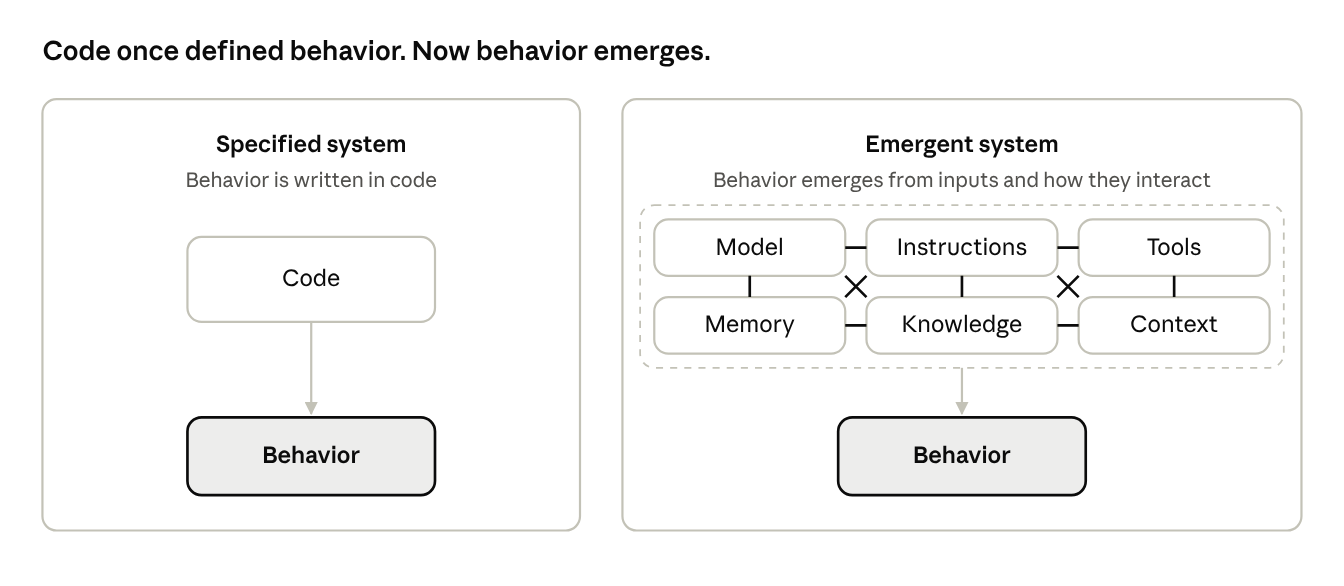
We spent decades learning to build software better. Now software evolves through intelligence, interaction and autonomy, and it's time to rethink how we develop it.
The website lesson: agents are becoming the front door
Not long ago, a company's website was a digital brochure. Marketing owned it, it changed occasionally, and few saw it as central to the business.
Then it became the storefront, the transaction and the customer relationship: the front door. Companies learned they couldn't afford to lose control of how it behaved.
Agents are on the same path, only faster. Within a few weeks this fall, Meta launched Muse, OpenAI unveiled Dots, and Instinct raised $1 billion to scale its own. These agents are becoming how people discover, engage and transact with businesses, and they increasingly hold the customer's context and intent.
So businesses must do more than build agents. They must operate at this layer: exposing their services, data and policies to agents, while keeping control of how their own agents act.
The website was the front door. The agentic layer is quickly becoming the next one.
When nothing changes, but behavior does
Imagine an airline's customer service agent. For months, it handles disruptions the same way: apologize, rebook, and offer a meal voucher when policy allows.
Then, overnight, it starts offering hotel stays and full refunds travelers aren't entitled to.
The team investigates. The code hasn't changed. Neither have the instructions or the policy documents. The pipeline is green.
So what changed?
Perhaps the model read the same instructions differently. Perhaps runtime context, or another component, shifted how it decided. Either way, behavior changed while every artifact we track stayed the same.
Our development playbook was never built for that problem.
Specified systems versus emergent systems
Our development methods assume behavior is specified in code. Waterfall structured the lifecycle. Agile made it iterative. Git let us track and merge every change. They remain essential.
But an agent's behavior comes from the interplay of its model, instructions, tools, memory, knowledge and context. It is an emergent system: behavior arises from those parts and how they interact, and it can shift even when no single part changes.
We are moving from building software artifacts to engineering behavioral systems that evolve.
Four shifts the old playbook cannot absorb
- The unit of change is no longer just code. A commit can't describe a version of an agent. A model upgrade, an instruction edit or a new knowledge source can change behavior without touching code. We need to version the whole behavioral configuration.
- Feedback must move at the speed of interaction. Agents meet new scenarios every day. Production failures should flow straight into experiments, evaluation and fixes, not wait for the next sprint.
- Collaboration is becoming parallel and behavioral. Engineers and agents now change different parts of a system at once. Their work can merge cleanly in source control and still conflict at runtime.
- Evaluation must become part of evolution. Passing tests doesn't mean an agent will decide well in unfamiliar situations. Every meaningful change should carry evidence of what changed, why, and whether the new behavior is acceptable.
A different discipline: Lineage
What would a methodology built for this era look like? I've been exploring one I call Lineage. It treats an agent not as a series of releases but as a family of behavioral generations, each with its own history, evaluation evidence and link to the versions before it.
Lineage rests on five principles:
- Behavioral versioning. Track the complete configuration that defines how an agent behaves: model, instructions, tools, memory and knowledge, not just code.
- Continuous evaluation. Make evaluation part of every meaningful change, not a final gate before release.
- Parallel evolution. Let multiple behavioral variants develop and run side by side as controlled experiments.
- Selective succession. Promote validated capabilities into the next generation instead of blindly merging every change.
- Governed evolution. Preserve accountability, behavioral history and the ability to restore a trusted state.
The lifecycle becomes a loop:
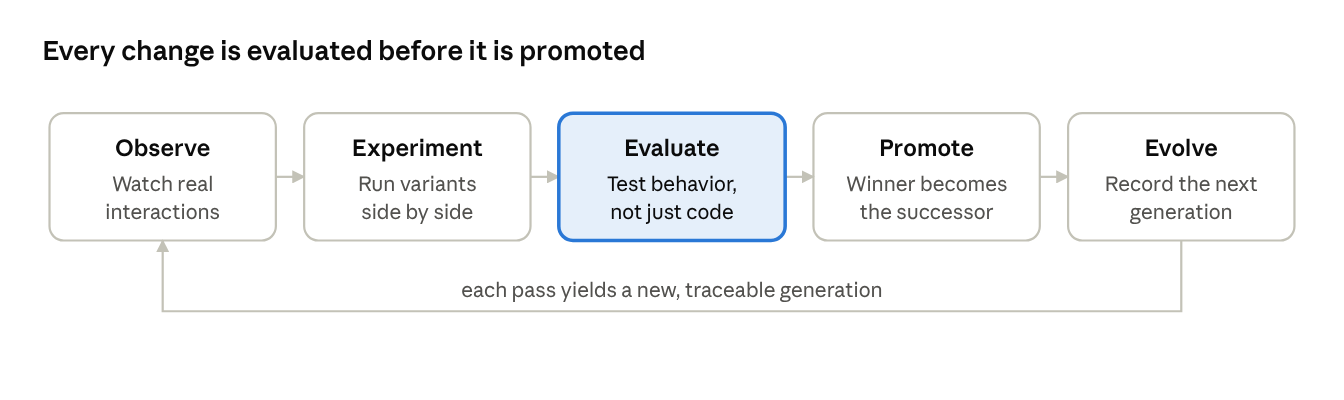
Websites learned this long ago. Teams don't debate a new checkout flow or recommendation feature; they run versions on a share of traffic and let the results decide.
Agents need the same discipline for behavior. Consider five variants of an airline agent, each receiving a portion of flight disruption traffic and testing a single adjustment: an upgraded model, modified instructions, integration with a live seat-availability tool, earlier human escalation, and the current baseline. Every variant is evaluated against identical metrics: resolution efficiency, customer satisfaction, and operating cost. Policy compliance remains absolute; any variant issuing unauthorized refunds is immediately disqualified, regardless of user satisfaction.
If human escalation proves superior, agent evolution diverges from traditional web development: the winner doesn't simply ship. It becomes the parent of the next generation, spawning five successor variants that test further refinements as the loop repeats.
The agent your customers meet next quarter won't be a release someone shipped. It will be the descendant of the experiments that survived. The goal isn't to stop agents from changing. It's to make their evolution observable, measurable, reproducible and governed.
What leaders can do now
You don't need a new methodology to start. Ask three questions:
- Can we reproduce behavior? Do we know the exact model, instructions, tools, memory and knowledge behind an agent's decision?
- Can we measure behavior? Do we continuously evaluate real-world outcomes, including after model and configuration changes?
- Can we govern succession? Can we run controlled variants, promote validated improvements, trace their lineage and roll back when necessary?
If any answer is no, you don't have a process gap. You have an engineering discipline gap.
From building software to evolving intelligence
Companies learned, sometimes the hard way, that their websites were too important to leave uncontrolled. The same lesson is coming for agents, faster.
Agile taught us to build software iteratively. The agentic era asks us to evolve intelligence responsibly. Soon the most important engineering artifact may not be the code we ship, but the behavioral lineage of the systems we run.
Does your organization know what its agents have become, and why?
If you're building production agents, I'd love to hear what you think needs to change.
Originally published on LinkedIn and Substack, Nov 6, 2026. Pavan Ghantasala is an Expert Agent Builder and Forward Deployed Engineering leader at Salesforce, helping enterprises deploy agentic AI. Opinions are his own and do not represent the views of his employer or affiliations.